
Table of Contents
- Why a Handcrafted Wood Rocking Horse Beats Mass-Produced Plastic
- Wooden Rocking Horse Safety Standards Every Parent Should Check
- Choosing the Right Wood: Hardwood, Pine, Maple, and Walnut Compared
- The Benefits of Wooden Toys for Toddlers: Balance, Motor Skills, and More
- Sizing, Assembly, and Weight Capacity: Matching the Horse to Your Child
- How to Clean Wooden Toys and Maintain a Rocking Horse for Generations
- What to Look For When Buying: A Quick Comparison Framework
- Frequently Asked Questions
Last Updated: September 22, 2026
Why a Handcrafted Wood Rocking Horse Beats Mass-Produced Plastic
A wood rocking horse is functional furniture a toddler climbs onto, grips, and pushes against for years, and the material decides whether it survives. This guide from Amish Country Cupolas and Toys covers safety standards, wood selection, sizing, and long-term care.
Mass-produced plastic rockers are cheap and light, but they flex under load, fade in sunlight, and typically end up at a curb within two or three years.
Wooden Rocking Horse Safety Standards Every Parent Should Check
Wooden rocking horse safety standards are the published testing requirements a toy must pass before it can legally be sold in the United States, covering lead content in paint and whether small parts break off under stress. Ask any seller for documentation.
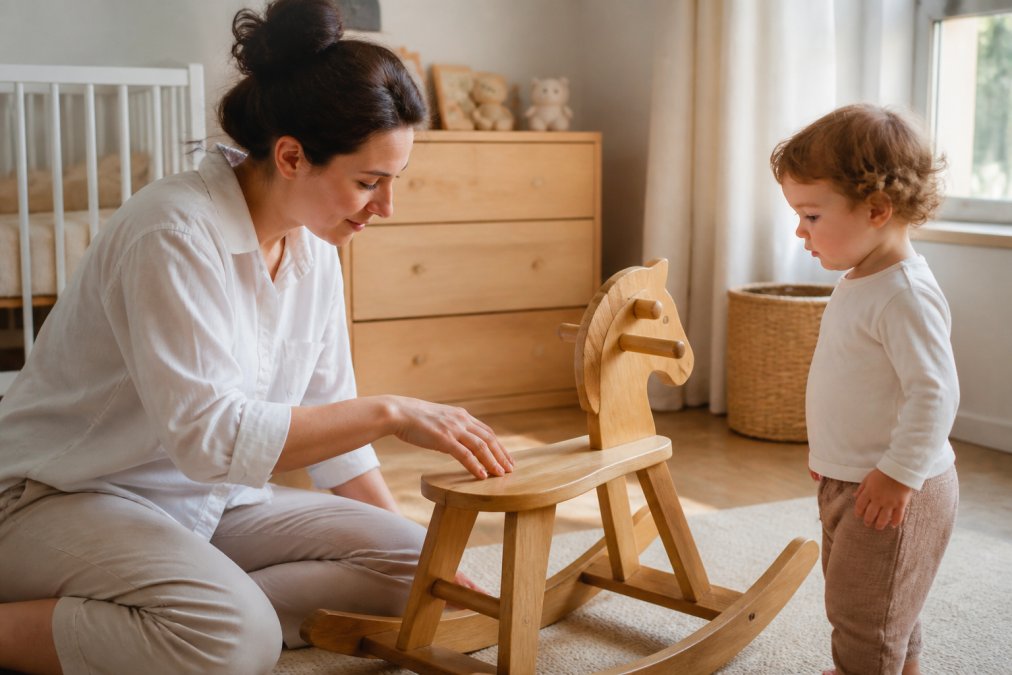
Three checks matter most:
- ASTM F963 covers mechanical hazards, sharp edges, and structural integrity under load.
- CPSIA limits lead and phthalates in children's products and requires third-party testing.
- Non-toxic finish disclosure confirms the stain or paint is child-safe, not just "natural looking."
ASTM F963 and CPSIA: What the Testing Actually Covers
ASTM F963 is the toy safety specification U.S. law makes mandatory, and CPSIA is the federal statute that enforces it. Together they require third-party lab testing for lead, phthalates, and mechanical hazards.
Choosing the Right Wood: Hardwood, Pine, Maple, and Walnut Compared
Wood species differ in density, grain, and finish behavior, which show up in how heavy the rocker is to move, how it handles chewing and scraping, and how many years it survives. Here is the breakdown.
|
Wood |
Density |
Typical Weight Feel |
Splinter Behavior |
Finish Behavior |
Longevity Under Heavy Use |
|---|---|---|---|---|---|
|
Pine |
Soft |
Lightest of the group |
Dents rather than splinters, but edges can crush and fuzz |
Soaks stain unevenly; blotching common |
Roughly one childhood of moderate use |
|
Maple |
Hard, dense |
Noticeably heavy |
Clean edges when cut; resists splintering under stress |
Takes stain evenly; also finishes well clear |
Decades; the standard for heirloom builds |
|
Walnut |
Hard, dense |
Heaviest common option |
Strong grain; holds detail without chipping |
Rich natural color; often finished clear rather than stained |
Decades, with the caveat that it dents less but shows scratches more |
|
Oak |
Hard, open-grain |
Heavy |
Pronounced grain can lift at edges if not sealed |
Takes stain well but grain is visually loud |
Decades; traditional look |
|
Cherry |
Hard, medium density |
Moderate |
Smooth edges; minimal splintering |
Darkens with age and light exposure |
Decades; ages visibly |
The Benefits of Wooden Toys for Toddlers: Balance, Motor Skills, and More
The benefits of wooden toys for toddlers come down to feedback timing. A wooden rocker responds to weight shifts immediately and predictably, lean forward, it tips forward; lean back, it tips back. That consistent loop lets a toddler's brain map cause to effect. A plastic rocker flexes under load, so the same lean produces a different response each time.
Vestibular Development: What the Rocking Motion Actually Does
The vestibular system is the inner-ear structure that senses head position and movement and tells a child which way is up. Rocking provides linear acceleration in the forward-back plane, one of the inputs it uses to calibrate balance. Occupational therapists use rocking as a calming, organizing activity because the motion is predictable and self-paced, the child controls the speed.
A few practical implications follow from this:
- Self-paced motion beats adult-paced motion for building a child's sense of control. A rocker the child drives themselves does more for vestibular calibration than a device an adult operates.
- Smooth, low-friction rocking is better than jerky rocking. A well-balanced rocker with a proper rocker-arc radius moves in a smooth arc; a poorly balanced one lurches.
- Short sessions are normal. Toddlers typically rock in bursts of a minute or two, then get off and do something else. That is how vestibular input is usually consumed.
Balance, Core Strength, and Proprioception
Staying on a rocking horse requires continuous small corrections, the child shifts weight to keep moving and avoid sliding off. That is core work and proprioceptive work: the body's sense of where its parts are in space. Gripping the handles adds a hand and forearm component, and mounting and dismounting independently adds planning and coordination.
Motor Skills and the Cause-and-Effect Loop
A toddler pushing a rocker is running an experiment: push harder, go faster; stop pushing, slow down. Wooden rockers make it legible because the response is consistent.
Ergonomics: The Spec That Decides Whether Any of This Happens
Ergonomics decides whether a rocker works. Three measurements matter:
- Seat height relative to the child's inseam, so feet can reach a stable surface.
- Handle position at a height and width the child can grip without leaning forward past the point of balance.
- Rocker arc radius, a longer, shallower arc rocks more slowly and is easier to control; a short, steep arc rocks faster and is easier to tip.
A rocker that is ergonomically wrong will be abandoned, whatever the developmental theory says. The practical test: if a child can mount, rock, and dismount without an adult steadying them, the geometry fits their size.
Sizing, Assembly, and Weight Capacity: Matching the Horse to Your Child
Weight capacity and seat height decide whether a rocker works for your child. Most wooden rockers are built for a range rather than a single age, so match seat height to your child's inseam and check the stated limit.
A practical sizing guide:
- Under 18 months: seat height around 20-23 cm, with adult supervision at all times.
- 18 months to 3 years: seat height around 25-30 cm, the most common range.
- 3 to 5 years: seat height 30-35 cm, with a wider base for stability.
- Weight capacity: look for a stated limit, and treat anything unstated as a red flag.
How to Clean Wooden Toys and Maintain a Rocking Horse for Generations
Knowing how to clean wooden toys without damaging the finish is the difference between a piece that lasts decades and one that looks tired in five years. Damp cloth, mild soap, immediate drying.
What to avoid:
- Soaking or submerging the wood in water
- Abrasive cleaners or scouring pads
- Leaving the rocker in direct sun for extended periods
- Harsh solvents that strip the finish
Refinishing and Restoring an Older Rocking Horse
Restoration is one of the strongest arguments for buying wood. An older rocker with worn finish, minor scratches, or faded stain can usually be brought back with sanding and a fresh coat of non-toxic finish.
What to Look For When Buying: A Quick Comparison Framework
Use this framework to compare any two rockers side by side. The goal is the one that matches how long you intend to keep it.
|
Check |
What Good Looks Like |
Why It Matters |
|---|---|---|
|
Wood type |
Maple, walnut, or oak |
Survives heavy use |
|
Finish |
Stated non-toxic, child-safe |
Safety and longevity |
|
Construction |
Solid wood, no particle board |
Holds shape under load |
|
Assembly |
Fully assembled or clear hardware |
Safety and setup time |
|
Weight capacity |
Stated limit |
Matches child's growth |
|
Certification |
ASTM F963 and CPSIA records |
Legal compliance |
Frequently Asked Questions
What are the safety standards for wooden rocking horses?
In the United States, children's toys should meet ASTM F963, the Standard Consumer Safety Specification for Toy Safety, which covers mechanical hazards, small parts, and surface coatings. Toys must also comply with CPSIA requirements for lead and phthalate limits. Ask the maker for third-party test documentation before buying. A well-built wood rocking horse also needs a wide base for stability, rounded and sanded edges, and a non-toxic finish. Amish Country Cupolas and Toys builds with these child-safe standards in mind.
At what age can a child safely use a wooden rocking horse?
Most children are ready between 18 months and 3 years, once they can sit steadily and hold on without support. Smaller horses suit toddlers, while larger models work for kids up to age 6 or beyond. Check the weight capacity before buying and always supervise younger riders. A rocking motion helps develop balance and motor skills, but the child needs enough core strength to stay seated. If your child cannot yet sit unassisted, wait a few months.
How do I clean and maintain a wooden rocking horse?
Wipe the surface with a damp cloth and mild soap, then dry immediately. Avoid soaking the wood or using harsh chemicals, which can strip the finish. For deeper cleaning of unfinished wood, a light sanding with fine-grit paper refreshes the surface. Reapply a child-safe oil or wax every 6 to 12 months, and check screws, bolts, and rocker joints for tightness. Store the horse indoors away from direct heat to prevent cracking.
What is the best wood for a rocking horse?
Hardwoods like maple and walnut offer the best durability and hold fine detail well, which is why heirloom-quality makers favor them. Pine is lighter and more affordable but dents more easily. Whatever the species, look for solid wood construction rather than plywood or particle board, a sanded finish with no splinters, and a non-toxic stain or natural finish. The wood grain should be tight and consistent, a sign the piece was built to last.